
Seed Atlas
Learn, in 3D, the seed structure, storage tissue, germination, sprouting, and geography of eight essential crops.
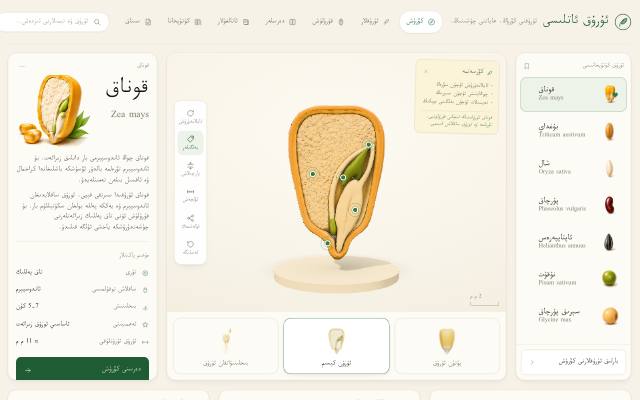
What is this tool?
Seed Atlas is a crop-science atlas showing the seeds of eight staple crops in 3D: wheat, rice, maize, bean, soybean, pea, cotton and sunflower. It reads in Uyghur and English.
What is it used for?
A seed's inner structure and germination are hard to see with the naked eye. Turning each seed around in a 3D model and learning its structures through markers brings biology and agriculture lessons to life.
How is it used?
Choose a seed in the seed library and open its whole, sectioned or germinating state. Rotate and zoom the model, click markers to read about each structure, then check what you learned with a lesson and quiz. You can also set two seeds side by side at true scale.
Who is it for?
Biology and agriculture students, teachers, and anyone interested in plants.
Getting started
- Choose a seed from the seed library.
- Pick its whole, sectioned or germinating state.
- Rotate and zoom the model, and click a marker to read about a structure.
- Read the lesson, then test yourself with the quiz.
Frequently asked questions
- Which crops are in the atlas?
- Eight: wheat, rice, maize, bean, soybean, pea, cotton and sunflower. Each has three 3D models.
- Can I use it offline?
- Yes. You can save the whole atlas to your device and use it without an internet connection.
Also known as
- ئۇرۇق ئاتلىسى
- Uruq atlisi
- Уруқ атлиси
- Seed Atlas
- زىرائەت ئىلمى
- 3D seed anatomy
- crop science Uyghur