
Mimar
An atlas of Uyghur architecture: eight buildings, a map, a timeline and an architecture glossary. Its 3D models are still being prepared.
What is this tool?
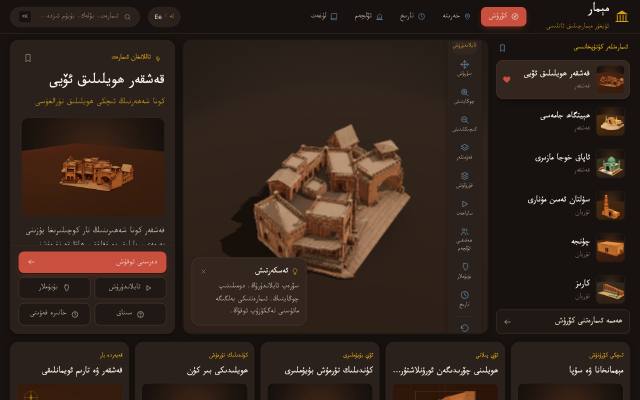
Mimar is a 3D atlas of Uyghur architecture. Turn eight buildings — including a Kashgar courtyard house, the Heytgah Mosque, the Emin Minaret, a karez and the Bezeklik caves — and read about each of their parts.
What is it used for?
Information about Uyghur architecture is scattered, and most of it is in other languages. Mimar brings the buildings, how they are built and the architectural terms together in Uyghur.
How is it used?
Choose a building, turn it in the 3D viewer and tap its markers to read about each part. Construction shows how the building rises, and True scale shows its size next to a 1.7-metre person. There is also a map, a timeline and an architecture glossary.
Who is it for?
Anyone interested in Uyghur architecture, architecture and history students, and teachers.
Getting started
- Choose a building from the atlas.
- Turn it in the 3D viewer and tap the markers to read about each part.
- Try Construction, Tour or True scale.
- Explore the map, timeline and glossary pages.
Frequently asked questions
- Are the 3D models the real buildings?
- Not yet. The current models are temporary placeholders, and the viewer shows a warning badge while the real models are being prepared. The descriptions, map, timeline and glossary all work.
- Can I read it in Latin script?
- Yes. The "ئە / Ee" button at the top switches between Arabic script and Latin script (ULY). The site also works offline.
Also known as
- مېمار
- Mémar
- Мемар
- Mimar
- ئۇيغۇر مېمارچىلىقى
- Uyghur memarchiliqi
- Uyghur architecture