
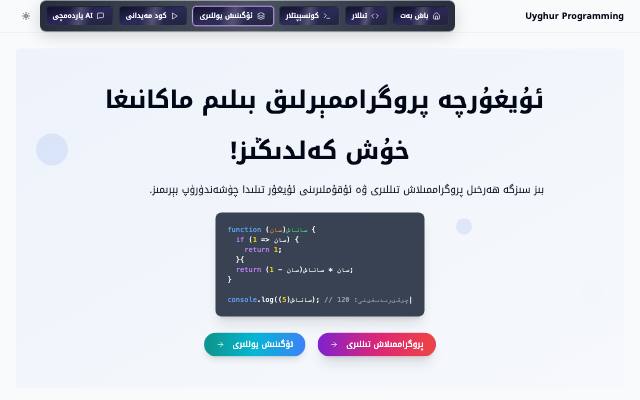
What is this tool?
Programming Languages (Uyghur Programming) is a platform for learning to code in Uyghur. It has lessons in HTML and CSS, JavaScript and Python, a code playground, exercises, projects and a glossary.
What is it used for?
Most programming material is in English, and newcomers struggle with the terms and error messages. Lessons explained in their mother tongue make the core ideas easier to grasp.
How is it used?
Start from Languages or Learning paths. Each lesson has a Uyghur explanation, a code example and a self-test question. Try code directly in the playground and test yourself with exercises; there are also pages on common errors and a quick reference.
Who is it for?
Students starting to code from scratch, and teachers preparing programming lessons in Uyghur.
Getting started
- Choose a language under Languages — HTML/CSS, JavaScript or Python.
- Work through the lessons in order and answer each self-test question.
- Edit and run the code examples in the playground.
- Apply what you have learned with the exercises and projects.
Frequently asked questions
- Can I start if I have never programmed before?
- Yes. The lessons start from the basics, and the learning paths show which language to learn in which order, from beginner to advanced.
- Is there help with understanding code errors?
- Yes. The common errors page explains frequent mistakes in Uyghur, and the glossary gives the meaning of programming terms.
Also known as
- پروگرامما تىلى
- Programma tili
- Программа тили
- Programming Languages
- ئۇيغۇرچە پروگراممىلاش
- پروگرامما ئۆگىنىش
- Uyghurche programmilash
- learn programming in Uyghur
Related articles
Python AI Coding — Guide
Python AI library code examples — PyTorch, TensorFlow, pandas, scikit-learn, Transformers — for October 2026 versions
AIVibe Coding — AI Coding Guide
AI coding tools like Cursor, GitHub Copilot, Claude Code, v0 and Bolt — official pricing and a practical vibe coding workflow
TechnologyDocker & Containers — Complete Guide
Complete Uyghur guide to Docker, containers, images, volumes, networking, and deployment workflows